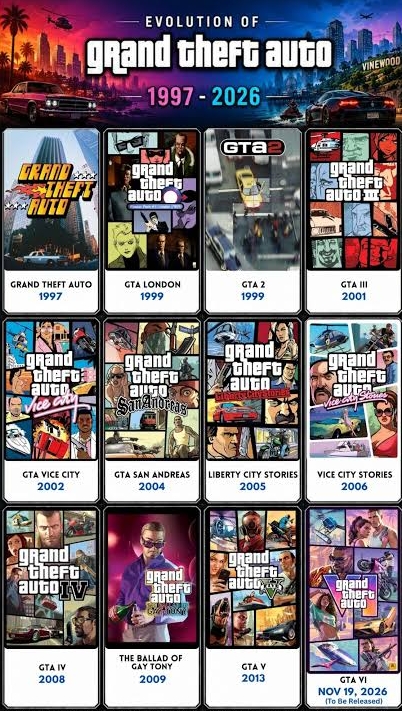
Article
Grand Theft Auto: The Evolution of the GTA Series
Freedom of movement and interaction with an urban environment have been central elements of Grand Theft Auto since the beginning of the series. Players control characters involved in criminal activities, accept assignments from different organizations, obtain vehicles, and explore cities inspired by real geographical locations. Although individual installments introduce different protagonists and storylines, they share an open-world structure that allows players to interrupt missions and participate in independent activities.
From Overhead Exploration to Three-Dimensional Worlds
The original Grand Theft Auto and GTA 2 use an overhead perspective, with progression based heavily on criminal assignments, financial objectives, and relationships with gangs. GTA 3 introduces a fully three-dimensional Liberty City and a storyline following Claude. Subsequent installments expand this format through additional character interactions, property ownership, recreational activities, and larger environments. GTA Vice City concentrates on the development of Tommy Vercetti’s criminal organization, while GTA San Andreas introduces physical character development, gang warfare, and three major cities connected by rural areas.
Major Games in the Grand Theft Auto Series
Each principal installment introduces a different combination of storytelling, exploration, and gameplay systems.
| Game | Main setting | Distinctive feature |
|---|---|---|
| Grand Theft Auto | Liberty City, Vice City, San Andreas | Open-ended criminal assignments |
| GTA 2 | Anywhere City | Gang reputation system |
| GTA 3 | Liberty City | Three-dimensional urban exploration |
| GTA Vice City | Vice City | Business acquisition and development |
| GTA San Andreas | San Andreas | Character statistics and territory control |
| GTA 4 | Liberty City | Relationships and alternative story outcomes |
| GTA 5 | Los Santos and Blaine County | Three playable protagonists |
| GTA 6 | Leonida and Vice City | Story centered on Jason and Lucia |
Gameplay Features Shared Across the Series
Despite differences between individual installments, several mechanics remain associated with the franchise:
- Open-world exploration and independent activities.
- Driving different categories of vehicles.
- Criminal assignments and character relationships.
- Police pursuits and wanted levels.
- Weapon acquisition and combat.
- Financial rewards and property ownership in selected installments.
- Hidden collectibles and optional challenges.
Later games introduce more detailed physical interactions, character animations, environmental systems, and narrative presentation. GTA V expands mission design through character switching and coordinated robberies. Grand Theft Auto VI continues the series with another interpretation of Vice City and the surrounding regions of Leonida. Rather than following a single protagonist throughout every installment, Grand Theft Auto creates separate criminal stories connected by recurring gameplay principles, fictional locations, and representations of American culture.